Core
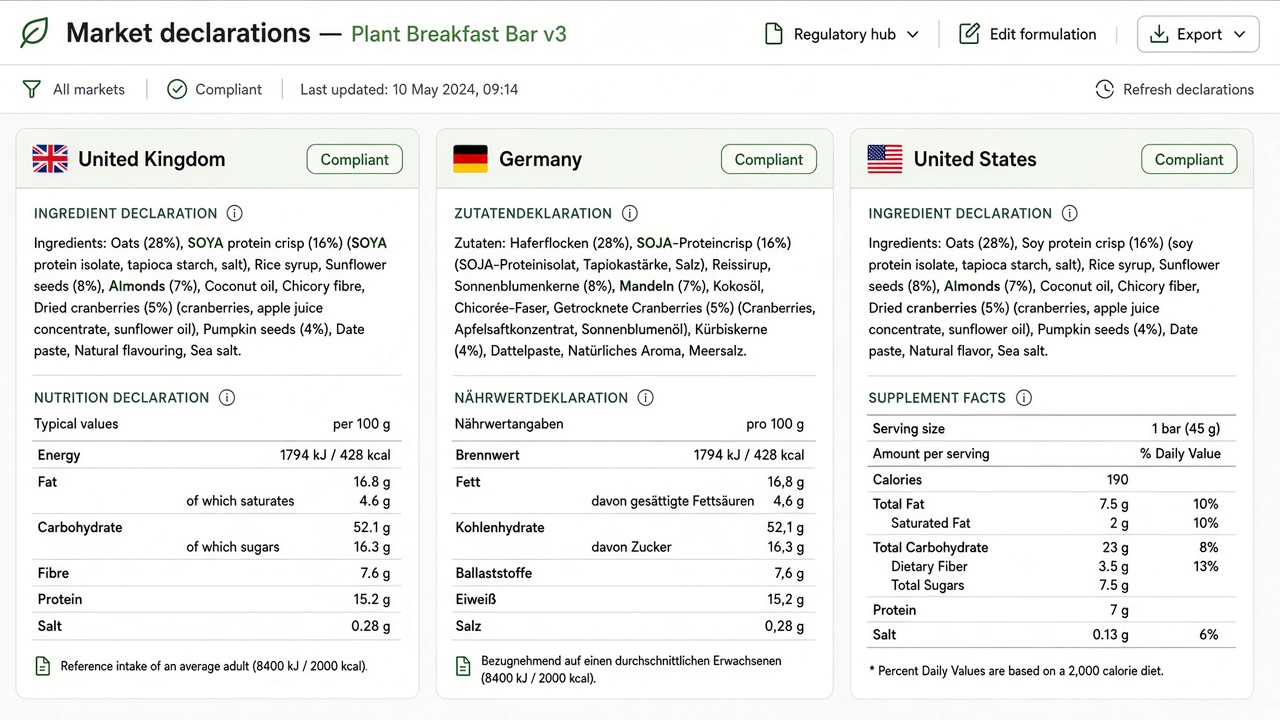
Multi-market declarations
Ingredient declarations, allergen expression, QUID where required, and nutrition values derived per UK, EU, and US rule sets and languages.

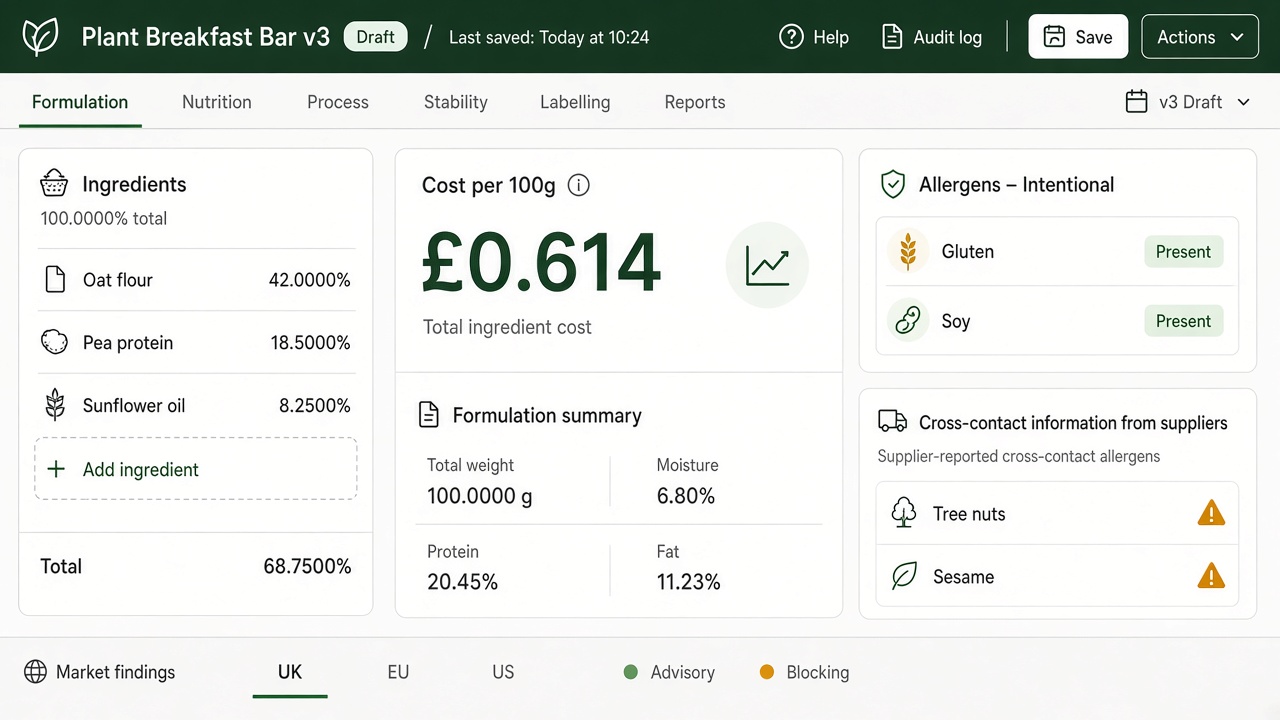
Build recipes from supplier materials, then see cost, allergens, nutrition, claims, and UK–EU–US findings update as composition changes.
The problem
Ingredient declarations, allergen statements, nutrition panels, and claim eligibility are consequences of the recipe. Change an ingredient and all of them move — differently by market and by the language the label must use.
Hand-built workbooks silently miss 100% totals, leave nutrition stale after reformulation, hide allergens one level down in compound materials, and discover market conflicts after launch plans are already set.
Capabilities
Core
Multi-market declarations
Ingredient declarations, allergen expression, QUID where required, and nutrition values derived per UK, EU, and US rule sets and languages.
Capability
Claims with limits
Nutrition claims evaluated against structured conditions. Health claim wording presented for human assessment. Marketing claims mapped to supplier attributes.
Capability
Cost and batch scale
Roll up material cost into finished-product cost with yield. Scale a version to a trial or production batch without altering the recipe.
Core
Change impact
When a supplier specification, qualification, or rule set changes, affected drafts and approved versions are identified for reassessment.
How it works
Step 01
Compose
Add supplier materials or nested formulations at stated proportions. The product shows the running total, cost, allergens, nutrition, and claim status as you work.
Step 02
Assess markets
Target the territories you sell into. Findings explain where a version is blocked or advised against — and why — before you submit.
Step 03
Derive declarations
For each market and language, generate ingredient, allergen, and nutrition content from recorded legal names and rule-set data. Gaps are reported, never silently filled.
Step 04
Approve and retain
An authorised reviewer approves for specific markets and claims. The version becomes immutable and records the supplier data, nested versions, and rule sets relied upon.
What changes
Professional responsibility
Formulation Designer reports findings against the rule sets it holds. It does not generate precautionary “may contain” statements, does not machine-translate regulated terminology, and does not claim that a product is legal to sell. Approval for a market remains an act of an authorised person.